WildRobin KYC and Verification
 Available in GB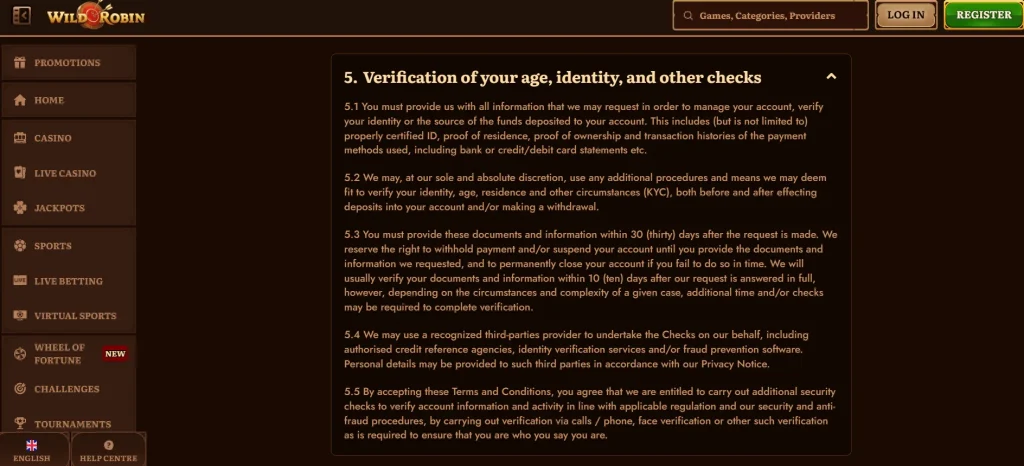
WildRobin
Updated 11 September 2026
WildRobin’s current Terms say verification requests can include properly certified ID, proof of residence, and evidence showing ownership or transaction history for payment methods used on the account. The company can also request information about source of funds. The Terms say documents and information are usually verified within 10 days after a request has been answered in full, but they also state that more time or additional checks can be required in a complex case.
The 10-day wording describes a usual processing period with variable completion time. The same Terms give customers 30 days to provide requested documents or information and allow WildRobin to withhold payment or suspend an account while required checks remain incomplete.
Table of Contents
- Verification categories WildRobin can request
- Identity documents
- Proof of residence
- Payment-method ownership and transaction history
- Source-of-funds and additional security checks
- The 30-day response period
- How long WildRobin verification takes
- How KYC can affect withdrawals
- What the Great Britain regulatory benchmark says
- Verification and licensing answer different questions
- A practical KYC response checklist
- Bottom line
- Recommend
Verification categories WildRobin can request
The broader product picture is combined in WildRobin casino review UK. Identity and account verification centre on the categories and procedures set out in WildRobin’s current Terms.
The current Terms group verification around four practical areas: identity, residence, source of funds, and ownership or activity of payment methods. The general KYC clause names properly certified ID, proof of residence and proof of ownership or transaction histories for payment methods, including bank or card statements, as examples of information that may be requested.
The wording is deliberately open-ended: the Terms say requested information “includes” the named categories, signalling examples rather than a closed checklist for every account. Account-specific instructions therefore govern the actual request, and WildRobin can add checks where circumstances require them.
Account-process context is covered by WildRobin registration. KYC begins from the same personal and payment information supplied during signup and can continue later in the account lifecycle.
Identity documents
WildRobin’s main KYC clause refers to “properly certified ID” and leaves the exact document set open for each case. Elsewhere, a refund-related clause gives examples such as a passport, driving licence or identity card. Those examples illustrate possible records while the actual KYC request determines the required document and format.
The useful distinction is between the category and the request. Identity evidence is clearly within scope. The exact document, certification standard and submission method should be taken from the live instruction WildRobin sends to the account holder.
Sensitive identity material belongs inside the authenticated account area or another verified WildRobin support channel. Brand names alone provide insufficient authentication for an address or upload portal.
Proof of residence
Proof of residence is another category named directly in the current Terms. It allows the operator to compare account residence details with supporting evidence. The general KYC clause leaves the residence-document list open, making the account-specific request the relevant instruction.
A separate refund clause mentions examples such as a utility bill, bank statement or rental agreement. These records show the types of evidence contemplated in at least one verification context. Acceptance, date limits, certification rules, image quality and file formats can still vary with the specific request.
Current registration details reduce avoidable verification friction. Address information that matches the account holder’s actual residence helps prevent urgent corrections during a document deadline.
Payment-method ownership and transaction history
WildRobin’s Terms specifically allow the company to ask for proof of ownership and transaction histories for payment methods used on the account. They also state elsewhere that the payment method used to fund the account should belong to the account holder. These provisions connect KYC directly with how deposits and withdrawals are made.
This is one reason to avoid depositing with another person’s card, bank account or payment account. Even if a transaction succeeds technically, later ownership verification can expose a mismatch between the account holder and the funding source. A cleaner account history is easier to explain than a chain of third-party payments.
Withdrawal processing and the distinction between WildRobin’s finance-department handling and payment-provider delivery are covered by WildRobin withdrawal.
Source-of-funds and additional security checks
The verification section also permits WildRobin to request information about the source of funds deposited to the account. In addition, the Terms allow extra procedures to verify identity, age, residence and other circumstances, and they mention calls, phone checks, face verification or other security checks where required by the operator’s security and anti-fraud procedures.
KYC therefore extends beyond a photo-ID upload. Identity can be followed by payment-ownership, transaction-activity or source-of-funds checks, and separate accounts can move through different verification paths or timelines.
The flexible wording supports account-specific instructions rather than a fixed universal checklist. The request attached to the individual account remains the controlling instruction.
The 30-day response period
The current Terms require requested documents and information within 30 days of the request. They also reserve the right to withhold payment or suspend the account until the material is supplied and describe permanent account closure as a possible consequence when the deadline passes before a complete response.
This 30-day period is different from the stated verification processing time. One is the period given to the customer to answer the request. The other is how long WildRobin says it usually takes to verify the documents after the request has been answered in full. Mixing those two clocks can create unnecessary confusion.
How long WildRobin verification takes
The strongest current timing statement appears in the official Terms: WildRobin says it will usually verify documents and information within 10 days after a request has been answered in full. A complete response is therefore the starting condition for that usual timeframe; a partial submission can extend the process.
The same clause allows additional time or checks depending on the circumstances and complexity of the case. Ten days is best understood as WildRobin’s published usual timeframe after a complete response, with complex cases capable of taking longer.
If a user has a time-sensitive withdrawal, the best way to reduce avoidable delay is to answer the exact request completely, make sure files are readable, and respond promptly if WildRobin asks for clarification or an additional check.
How KYC can affect withdrawals
WildRobin’s Terms connect verification directly to payments. They allow the company to delay a withdrawal while checking identity, account balance, source of funds and compliance with the Terms, and they allow payment to be postponed until required verification procedures are completed.
Separately, the Terms state that the finance department works through withdrawal requests within three business days after the request, or after the previous withdrawal has been paid, provided the other conditions are met and checks are complete. Completion of KYC therefore comes before reliance on that withdrawal-processing window.
The practical sequence is clear: complete the verification request first, then treat the published withdrawal-processing period as the next stage. KYC time and payment-provider delivery time are separate components of the overall payout timeline.
What the Great Britain regulatory benchmark says
For UK Gambling Commission licensees operating in Great Britain, the regulator says remote operators must verify a customer’s identity before allowing that customer to gamble, and additional verification information should be requested promptly rather than being delayed until withdrawal where it could reasonably have been requested earlier. The Commission repeated those existing requirements in August 2026.
That rule is a Great Britain regulatory benchmark. Brand-specific UKGC licensing requires separate evidence. The distinction between WildRobin’s own Terms and Great Britain licensing requirements is set out in WildRobin UK gambling rules.
Verification and licensing answer different questions
A detailed KYC process demonstrates account-control procedures, while regulatory protection depends on the operator’s verified licensing position. WildRobin’s current Terms provide useful detail about identity and payment checks; direct register evidence remains the appropriate basis for licensing conclusions.
Licence, reputation and protection evidence is set out in WildRobin licence UK. Keeping KYC and licensing distinct avoids treating verification procedures as a licensing signal and also avoids assuming that unresolved UKGC status removes the operator’s ability to request identity checks.
A practical KYC response checklist
- Read the exact request. Identify whether it asks for identity, residence, payment ownership, transaction history, source of funds or another check.
- Use the requested channel. Upload sensitive information only through a verified WildRobin route.
- Answer completely. Missing items can prevent a request from being treated as answered in full.
- Check readability. Make sure the submitted evidence is legible and matches the account data.
- Respect the 30-day response period. The Terms set that period for supplying requested material.
- Treat 10 days as the usual timeframe. The Terms attach that period to a complete response and allow longer checks for more complex cases.
- Keep KYC and withdrawal clocks separate. Finance processing can depend on the verification being completed first.
Bottom line
WildRobin’s KYC rules are unusually specific in the current Terms. They explicitly cover certified ID, proof of residence, payment-method ownership or transaction history, source-of-funds information and additional security procedures. Customers are given 30 days to provide requested documents or information, while WildRobin says a complete response is usually verified within 10 days and may take longer in complex cases.
The precise interpretation is straightforward: KYC can arise at different stages, document requirements stay account-specific, the published 10-day period describes the usual timing after a complete response, and incomplete verification can delay withdrawals. Account-specific instructions take priority over generic document checklists.